
 DEMOGOD
How AI Agents Are Replacing Chatbots for Product Discovery
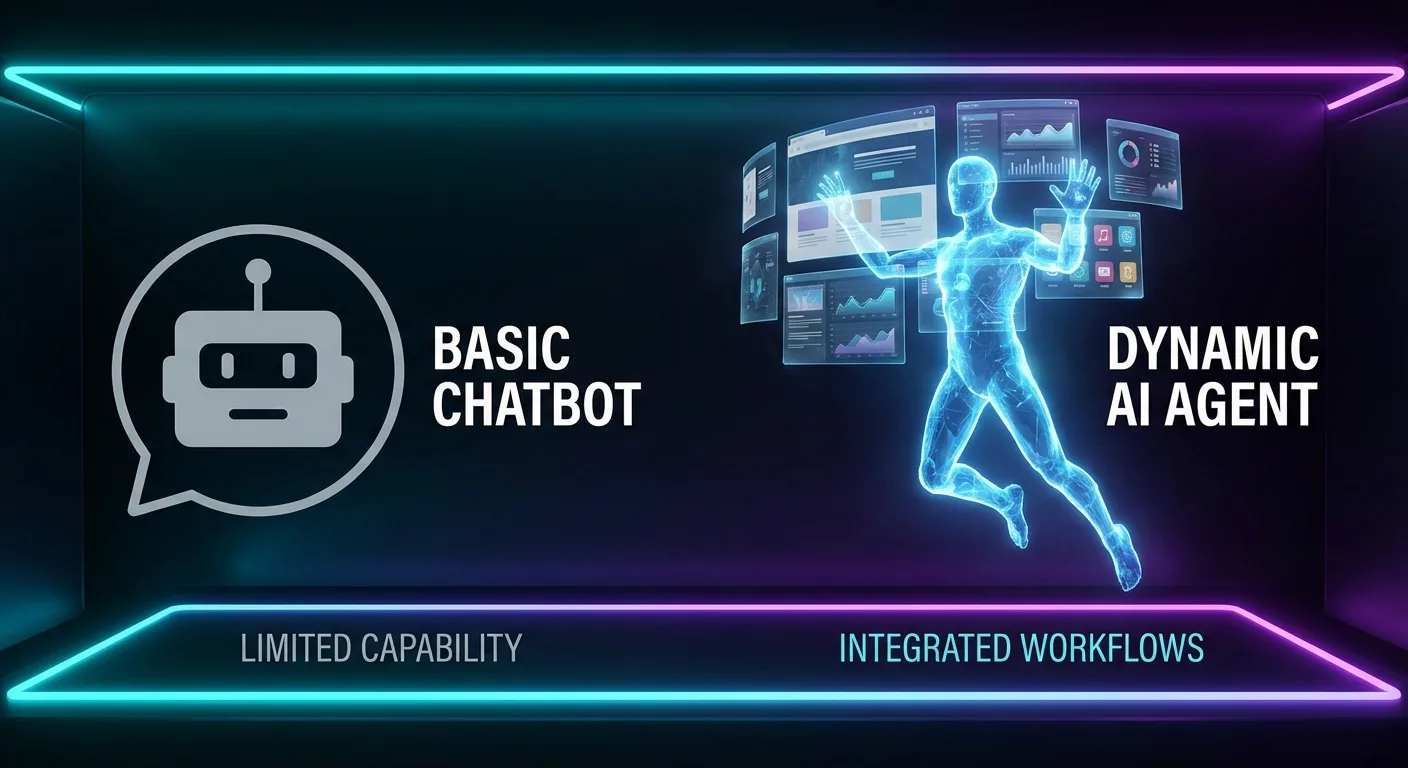
Chatbots had their moment. For years, they were the default solution for customer interaction on websites. But here's the uncomfortable truth: most chatbots are glorified FAQ search engines.
Users don't want to type questions and hope for relevant answers. They want someone—or something—to show them around.
Enter AI agents.
## The Fundamental Difference
**Chatbots react.** They wait for your question, search a knowledge base, and return the closest match. If your question doesn't fit their training data, you get the dreaded "I don't understand. Can you rephrase?"
**AI agents act.** They understand context, navigate interfaces, and execute tasks on behalf of users. They don't just tell you where the pricing page is—they take you there.
This isn't a subtle distinction. It's a paradigm shift.
## Why Chatbots Are Failing Product Discovery
Product discovery is fundamentally an exploration problem. Users don't always know what they're looking for. They're curious. They want to browse, compare, and understand.
Traditional chatbots fail at this because:
### 1. They're reactive, not proactive
Chatbots sit in a corner waiting for input. AI agents can guide users through a product, highlighting features based on context and behavior.
### 2. They're text-only
Most chatbots can only send text responses. AI agents can interact with the actual interface—clicking buttons, navigating pages, demonstrating features in real-time.
### 3. They're disconnected from the product
Chatbots operate in a bubble. They don't know what's on the screen or what the user is trying to accomplish. AI agents are DOM-aware—they understand the page structure and can respond accordingly.
### 4. They create friction, not flow
Every chatbot interaction requires the user to stop what they're doing, type a question, read a response, and then manually navigate. AI agents eliminate these interruptions.
## The Rise of Agentic Experiences
The shift from chatbots to agents mirrors a broader trend in AI: moving from tools that assist to tools that act.
Think about it:
- Email assistants evolved from spell-checkers to agents that draft entire responses
- Search engines evolved from keyword matching to AI that synthesizes answers
- Product demos are evolving from passive documentation to interactive, guided experiences
AI agents represent the next evolution of user interaction. They don't just provide information—they provide experiences.
## What Makes an Effective AI Agent?
Not all "AI agents" are created equal. The most effective ones share these characteristics:
**Context Awareness**
They understand where the user is in their journey and adapt accordingly. A first-time visitor gets a different experience than a returning customer evaluating enterprise features.
**Natural Language Understanding**
Users should be able to speak naturally—"show me how this integrates with Slack"—without learning special commands or syntax.
**Action Capability**
True agents can manipulate the interface. They can scroll to relevant sections, open menus, fill forms, and demonstrate workflows.
**Voice Interface**
The most advanced AI agents support voice interaction. Speaking is faster and more natural than typing, especially for exploratory tasks.
## The Business Case for AI Agents
Beyond the user experience improvements, AI agents make strong business sense:
**Higher Engagement**
Interactive guidance keeps users on-site longer and exploring more deeply than static content or chatbots.
**Better Conversion**
When users can ask "show me how this solves my problem" and immediately see a demonstration, the path to conversion shortens dramatically.
**Reduced Support Load**
AI agents handle the exploratory questions that typically overwhelm support teams—freeing humans for complex issues that require empathy and judgment.
**Scalable Personalization**
Every user gets a personalized guide without requiring a human sales team to scale.
## The Transition Is Already Happening
Forward-thinking companies are already making the switch. They're recognizing that the chatbot paradigm—born in the era of rule-based systems and keyword matching—doesn't leverage the capabilities of modern AI.
The question isn't whether AI agents will replace chatbots for product discovery. It's whether you'll be an early adopter or a late follower.
## Making the Shift
If you're still relying on chatbots for product discovery, here's how to start the transition:
1. **Audit your chatbot conversations** - What questions are users actually asking? How many end in frustration?
2. **Identify high-friction moments** - Where do users get stuck? Where do they abandon?
3. **Consider voice-first** - Voice interfaces reduce friction further and appeal to users who hate typing
4. **Start small** - Implement AI agents for specific workflows (like product tours or pricing exploration) before expanding
5. **Measure differently** - Move beyond "questions answered" to "tasks completed" and "user journeys guided"
## The Future Is Agentic
We're at an inflection point. The chatbot era is ending. The agent era is beginning.
Users will increasingly expect websites to understand their intent and act on it—not just respond with text suggestions. The companies that embrace this shift will create dramatically better user experiences.
The companies that don't will wonder why their chatbots aren't converting.
---
**Ready to see AI agents in action?** [Try the interactive demo](https://demogod.me/demo) to experience voice-controlled website navigation.
← Back to Blog